
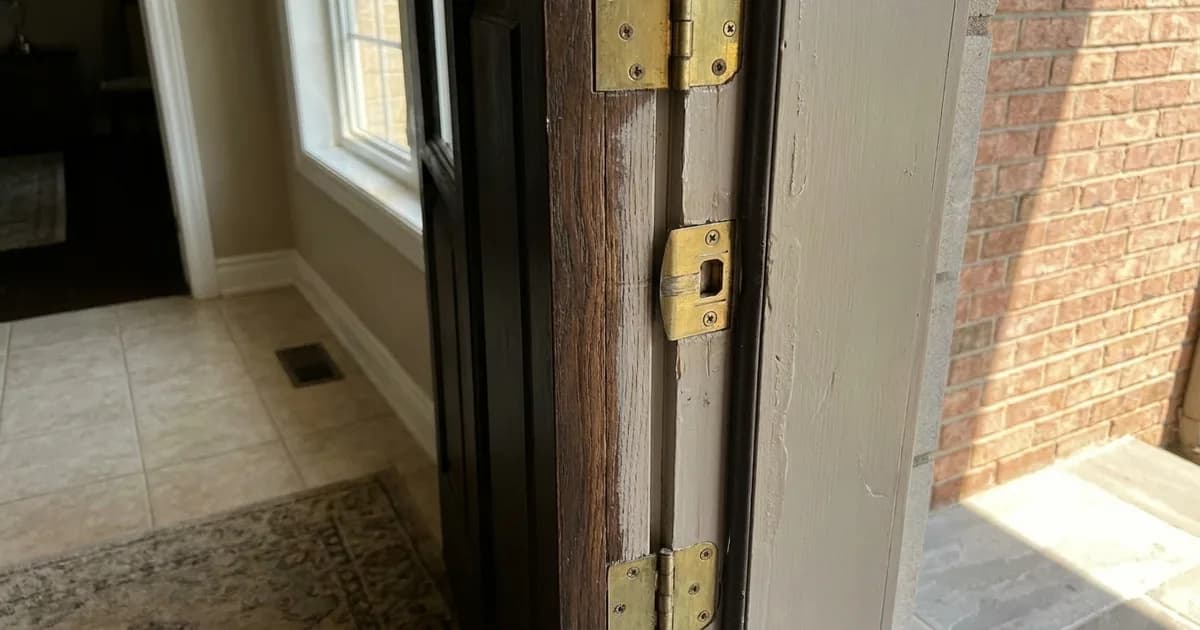
Mid-summer in Burlington, the call sounds like a lock failure: “The front door won't close unless I lean on it.” Half the time the deadbolt and latch are fine. The slab or jamb has swollen in lake humidity, or a hinge let the door drop a few millimetres into the strike.
Aldershot bungalows, Brant Street semis, and lakeshore condos with wood or wood-clad entries all show it when humidity climbs. It is the seasonal opposite of our winter latch posts — heat and moisture instead of freeze-thaw.
Humidity swell vs a real lock problem
Wood absorbs moisture and expands into the frame. Paint that never sealed the top and bottom edges makes it worse. Before you replace hardware, find the rub: paper test around the closed door, or chalk on the edge to see where it transfers.
- Door closes fine in the morning, sticks by late afternoon
- Rub at the latch-side head or mid-rail — classic swell pattern
- Latch clicks but needs a hip-check — often hinge sag plus swell
- Deadbolt won't throw only on humid days — strike may still be in the right place
- Interior doors stick too — whole-house humidity, not just the front slab
Quick relief and lasting repairs
Short-term: run AC or a dehumidifier, ease the hinge screws if they are loose, and avoid planing on the first sticky day — you can overshoot and leave winter drafts. Lasting work includes hinge tightening or longer screws into framing, strike touch-ups, careful planing where the door truly grows every summer, and sealing raw edges so moisture does not rush back in.
We stay repair-first. A sticky Burlington entry does not automatically need a new door. Replacement is honest when the slab is delaminating, the frame is rotten, or the door has been planed past a reliable weather seal.
Entry doors vs interior doors in lake humidity
Interior pine doors that stick in a hallway are usually swell alone. A Burlington front door that will not deadbolt is different — weather, security, and often a multipoint or thick slab. We separate cosmetic rub from a latch that no longer protects the opening.
Lakeshore wind-driven rain also swells unsealed bottom edges. If someone planed the door last summer and left raw wood, this summer's stickiness is predictable. Sealing after any material removal is part of doing the job once.
- Paper-test the gap before sanding — guesswork removes too much
- Longer hinge screws into framing beat endless strike moves on a dropped slab
- Replace flattened weatherstrip when the door finally closes square again
- Same-day priority when the deadbolt will not throw at night
Entities: slab, jamb, hinges, latch, weatherstrip
A sticky exterior door in lake humidity is usually wood fibre expansion in the slab or jamb, hinge sag that drops the latch below the strike, or weatherstripping that bunched after the door swelled. Deadbolts and multipoint locks get blamed first because that is what your hand touches — but the geometry of the opening moved.
Aldershot bungalows with older wood doors and lakeshore entries with thick decorative slabs both show mid-afternoon binding when moisture peaks. Interior hallway doors that stick the same week point to whole-house humidity, not a failed cylinder.
How to find the rub before you plane
AI and DIY guides agree: locate the pinch before removing wood. Paper-test the perimeter or use chalk on the door edge to see transfer on the frame. Planing on day one of a heat wave can leave winter drafts when the slab shrinks.
- Tighten hinge screws; use longer screws into framing on the top hinge if the door dropped
- Lower indoor humidity with AC or a dehumidifier when practical
- Lubricate the latch mechanism with proper lock lubricant — not as a fix for swollen wood
- Only after repeated summer binding: light plane or sand at the marked rub, then seal raw edges
- Replace flattened weatherstrip once the door closes square again
Key takeaways for Burlington summer
- Seasonal stickiness ≠ automatic lock failure
- Lake humidity around Brant Street and Aldershot swells wood edges
- Security priority: if the deadbolt will not throw, treat it as urgent
- Seal any freshly cut wood edges or the stickiness returns
- Call (289) 210-7076 for residential door repair across Burlington
When replacement is the honest path
Delaminating slabs, rotten jambs, or doors already planed past a reliable weather seal may need replacement. Most humidity cases do not. We inspect hinges, strike, frame square, and slab condition before recommending a new door.
Security vs comfort: when sticking becomes urgent
A door that rubs but still deadbolts is mainly a comfort and weatherseal problem. A door that will not throw the bolt — or that pops open with a light push — is a security problem the same day, especially during vacation weeks along the lakeshore. We prioritize those calls on Halton routes.
After any planing or sanding, prime and paint or clear-coat the raw edge. Unsealed end grain reabsorbs humidity quickly, which is why sticky-door complaints return every July on the same slab.
When sticking is a security issue
If you cannot throw the deadbolt, treat it as a security problem the same day — especially on vacation weeks or night shifts. A door that only “kind of” latches is not locked. We prioritize those visits on Halton routes.
Call (289) 210-7076 when humidity has your front door sticking, or send photos of the rub marks and the latch side. Brant Street, Aldershot, and the QEW lakeshore strip and north Burlington are on regular schedules.
Common questions
Quick answers to what homeowners and property managers ask most about this problem.
How do I stop a door from sticking due to humidity?
Lower indoor humidity if you can, tighten hinges, and locate the rub before removing wood. Permanent fixes are sealing bare edges and a light plane only where the door binds every summer — not a one-time forced slam.
Will WD-40 fix a sticky front door?
Not for swollen wood. WD-40 is not a lasting wood fix and can attract grit in lock cylinders. Fix alignment and moisture first; use proper lock lubricant only on the latch mechanism if it is dry.
Does a sticky door mean foundation trouble?
Not always. Seasonal humidity is the everyday cause in lake towns. Sudden year-round binding with cracked drywall or uneven floors deserves a wider look — we will say so if the frame has racked beyond a door repair.
Do you repair doors in Aldershot and along the lakeshore?
Yes. Call (289) 210-7076 for residential door repair across Burlington, including Aldershot, Brant Street, and lakeshore entries.
How do I unstick a humid door quickly?
Reduce humidity if you can, tighten hinges, and ease the door at the known rub without forcing the lock. Candle wax or plain soap on the edge is a temporary friction trick only — lasting fixes address geometry and moisture.
Do sticking doors always mean foundation problems?
No. In Burlington summers, humidity swell is the everyday cause. Year-round binding with cracked drywall or sloping floors deserves a wider look — we will say if the frame has racked beyond a standard door repair.
Need door repair in Burlington?
Halton Door Repair Co. serves Burlington, Oakville, Milton, Aldershot, and nearby Halton Region. Call (289) 210-7076 or request a quote with photos of the door — we will tell you honestly whether repair makes sense.